
Graphene Hollow Fiber Membrane

Driven by Purity: Redefining the Water Quality Standard with Advanced Filtration Technology

Product Description

Graphene hollow fiber membranes are advanced filtration materials that incorporate graphene into the structure of traditional hollow fiber membranes. The addition of graphene enhances key properties such as porosity, mechanical strength, and chemical resistance. Graphene Hollow Fiber Membranes offer superior filtration performance due to their highly porous structure, which increases permeability and provides greater resistance to fouling. With a high tensile strength of >200N, graphene hollow fiber membranes are more durable and can withstand higher pressures, contribute to lower maintenance costs and increased operational efficiency.

Download Brochure

Please click and fill a simple form to enable the brochure download.

Learn More

Need more information or a quote? Our team is ready to help.

What is Graphene Hollow Fiber Membrane?

World’s first mass production using CCPS (Composite Coating Phase Separation) technology for high mechanical strength and anti-fouling performance.

Hollow Fiber Membranes are precision filters that act as selective barriers, removing particles based on size. The membrane surfaces contain fine pores that determine which particles can pass through, based on a molecular weight cut-off value. Typically, water and small dissolved particles pass through the filter, while larger solid particles are retained and rejected.

Graphene Hollow Fiber Membrane features an in-house patented graphene-modified PVDF structure with internal support, providing outstanding flux and anti-fouling properties. It represents the world’s first mass-produced industrial graphene membrane, enhanced by CCPS technology.

Applications of Graphene Hollow Fiber Membrane

A key application of hollow fiber membranes is in water treatment and purification. These membranes are essential for removing contaminants, pathogens, and particulates, ensuring that water is safe for consumption and use across various industries. Their role in desalination, particularly in converting seawater into potable water, highlights their importance in addressing global water scarcity challenges.

Graphene Hollow Fiber Membranes are available in two forms: pressurised UF and submerged UF.

Technical Features of Graphene Hollow Fiber Membrane

Utilises Suntar’s Patented Materials

Made with Graphene-enhanced PVDF (Polyvinylidene fluoride) formula.

External Pressure (Out-In)

Reduces channel blockage and extends membrane lifespan.

Meets international standards for fiber breakage resistance.

Made with Graphene-enhanced PVDF (Polyvinylidene fluoride) formula.

Flexible Active Area

Offers 50–68 m² of active membrane area per module.

Key Benefits of Graphene Hollow Fiber Membrane

Exceptional Filtration Performance

Distributed graphene supports the membrane structure, and its pores reduce water resistance, giving a water flux 1.5-2.0 times higher than ordinary membranes.
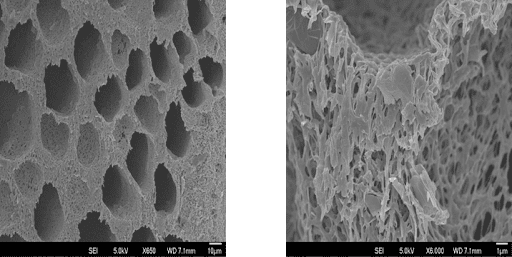
Two microscope images of the graphene hollow fiber membrane, showing its many tiny pores

Strong Anti-Fouling Properties

Hydrophobic groups formed on the graphene surface contributed to superior anti-fouling performance. This inherent hydrophobicity effectively repels hydrophilic pollutants during filtration, leading to a performance that is over 1.5 times greater than that of standard membranes. The result is an anti-fouling membrane that needs less cleaning and lasts longer than a standard PVDF fibre.
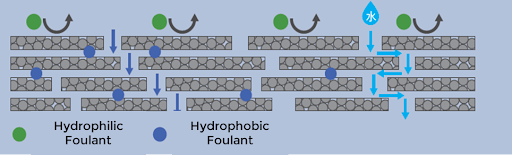
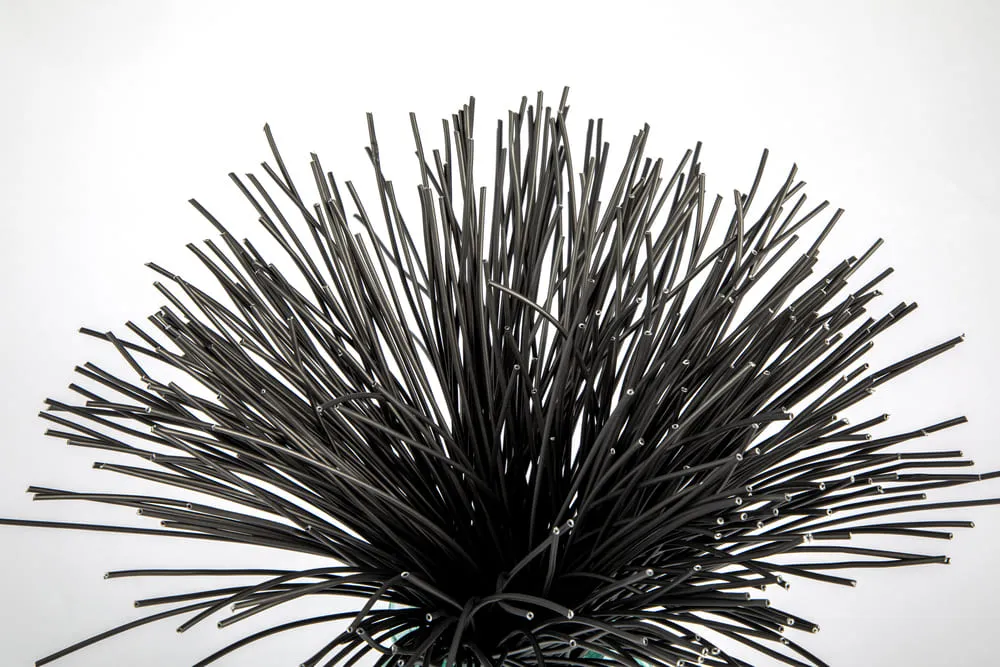
Diagram of the graphene membrane surface blocking dirt particles while letting water through

Product Portfolio

Bundle of black Suntar graphene hollow fiber membrane strands on a white background

Graphene Hollow Fiber Membrane

Graphene-enhanced PVDF ultrafiltration fibre, supplied as pressurised UF or submerged UF modules with 50-68 m² of active area.

Most Frequently Asked Questions

What is the difference between Hollow Fiber Membrane and Graphene Hollow Fiber Membrane?

Graphene is integrated into the formula during production, enhancing the membrane’s properties, such as increased strength, permeability, and chemical resistance.

Graphene offers higher porosity, greater fiber strength (>200 N), improved anti-fouling properties, and longer lifespan, all while maintaining similar flux.

Related Industries

From water treatment to process separation, discover how our innovative solutions drive sustainable performance across the global industries.

Data Centre Water Solutions

The Path to Net-Zero WUE

Chemical and Metallurgy

Industrial Water and Wastewater Treatment

Suntar provides industrial water and wastewater treatment systems for 12 industries, from power plants to oilfields, integrating proprietary membrane technologies developed and manufactured at our own production facilities. For sewage and town water, see our municipal wastewater treatment solutions.

Interested in learning more about what we do at Suntar?

We conduct various webinars on our solutions from time to time.

Download Brochure

Please provide us with your details to receive brochure.